
Criminal Court Records in Amite County
A criminal court record is the official case file built when the state brings charges against a person. In Amite County, that file is opened and kept by the clerk of the court hearing the case. For felonies, the Circuit Clerk serves as clerk of the Circuit Court and receives the indictment, motions, orders, and related criminal papers. The clerk also records each judgment and execution as a case closes. The file grows entry by entry, from the first paper filed to the final order. It is a running account of how the State of Mississippi and the defendant moved through the court.
Criminal cases here do not all start in the same place. The county's court page says every felony is first heard in Justice Court for an initial appearance and the filing of an affidavit. Justice Court judges hold court at the jail three times each week so an arrested person sees a judge within three days. The Circuit Court, sitting in the 6th Circuit District, is the felony trial and indictment court. District Attorney Timothy Cotton prosecutes felony, misdemeanor, and juvenile cases for the district from his Natchez office. County Prosecuting Attorney Sara Hemphill handles felony matters before justice or county court, criminal appeals to circuit court, and matters taken to the grand jury. The charges that begin a case are detailed in the Amite County arrest records and court charges, while the full case file stays with the Circuit Court.
The Mississippi Bar lays out how these courts fit together on its court structure page.
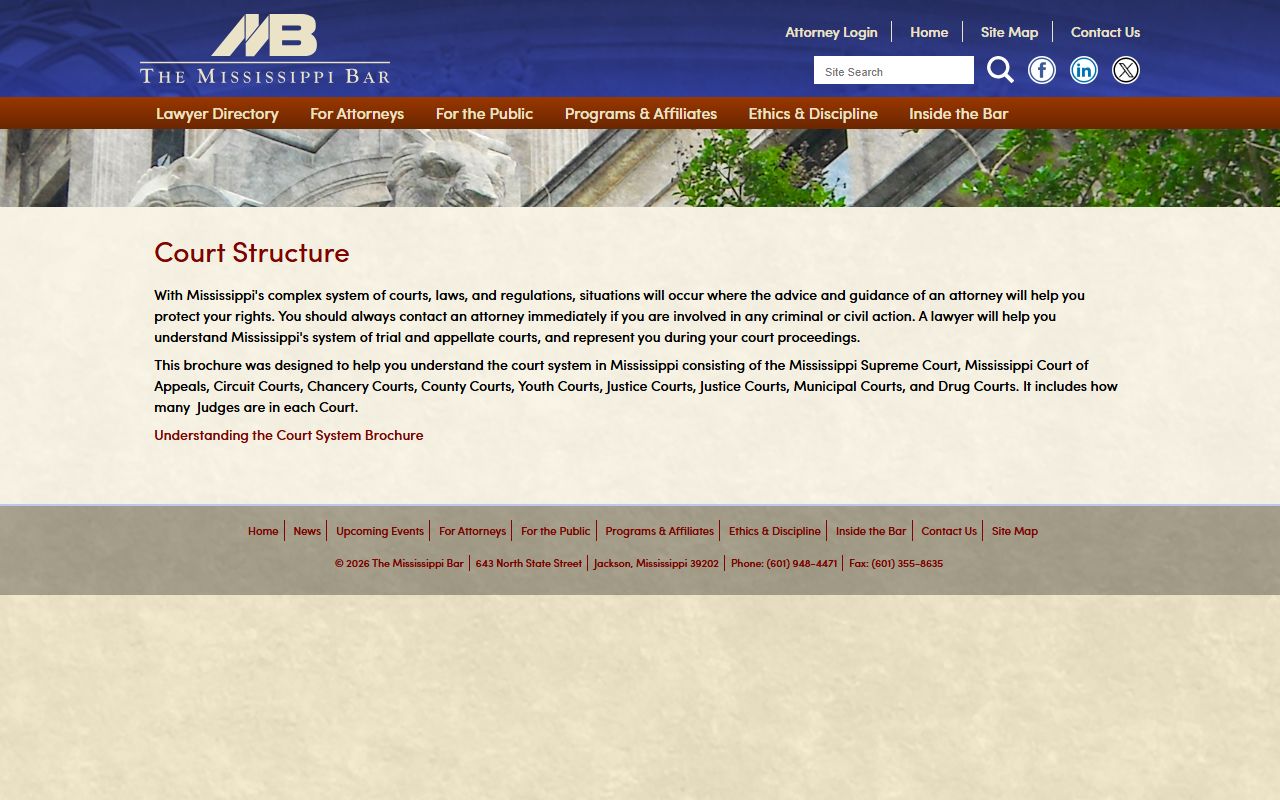
That chart places Circuit Court above Justice Court, the same path an Amite County felony record follows from a first appearance to an indictment and trial.
How to Search Amite County Criminal Court Records
Amite County does not run a single branded criminal records search site. Access depends on the court and the stage of the case. Mississippi Electronic Courts, known as MEC, is the statewide electronic filing system, and the public side is reached through PAMEC. Amite County Circuit Court moved to mandatory attorney e-filing in March 2025, so newer felony filings increasingly sit in that system. Remote public viewing through PAMEC needs a registered account, and per-page charges apply. Courthouse public terminals and the clerk counter remain the fallback for anyone who cannot or will not pay for remote access.
- Identify the court that holds the case. Use Circuit Court for felony files and Justice Court for the early affidavit and initial appearance.
- Register with PAMEC and select the court when the case is electronic and remote access is needed.
- Search by the defendant's name or the case number, then narrow by court and filing date.
- Open the case to read the docket entries, the plea, and the disposition.
- Ask the Circuit Clerk for a certified copy when a court-ready document is required.
Some records never reach the online system. Older felony files, sealed cases, and matters that started by affidavit in Justice Court may only be available at the counter. Circuit Clerk Celeste Bell McIntyre can be reached at 601-657-8932 or by mail at PO Box 312, Liberty MS 39645. Justice Court answers at 601-657-4527 for lower-court charge and bench-warrant questions. Because Amite County has not published a copy-fee schedule, confirm certification costs with the office before sending payment.
Note: Remote PAMEC viewing requires a registered account and per-page fees, so a courthouse terminal stays the no-cost way to read an Amite County criminal file.
Stages of an Amite County Criminal Case
A criminal case is built in stages, and each stage adds new papers to the file. The record starts with the charge and a first appearance, then moves toward an indictment, a plea, and a final outcome. Reading the docket in order shows exactly where a case stands.
Case flow: Charges Filed or Affidavit › Justice Court Initial Appearance › Indictment › Arraignment › Pretrial and Motions › Plea or Trial › Disposition › Sentencing › Appeal
In Amite County the path usually opens with an affidavit or charge and a Justice Court appearance within three days of arrest. A grand jury can then return an indictment, the formal felony charge, which is filed with the Circuit Clerk. At arraignment the defendant hears the charge and enters a plea. Pretrial hearings handle motions, evidence questions, and bond. The case then ends in a plea or a jury trial, and the judge enters a disposition. Sentencing follows a conviction, and either side may carry an appeal into the Mississippi Court of Appeals.
The Mississippi Bar also publishes a plain-English guide to understanding the court system for residents new to these steps.
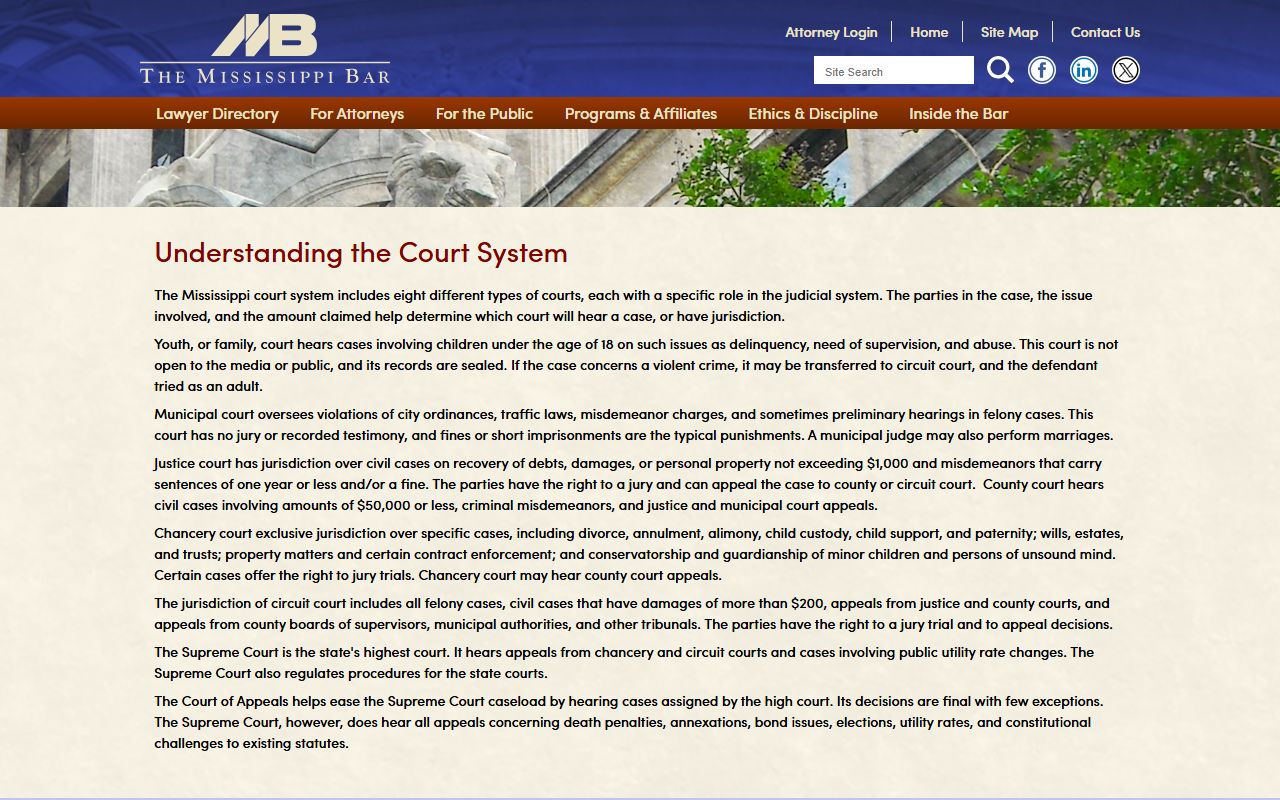
Its breakdown of trial and appellate courts mirrors the route an Amite County criminal court record travels from arraignment through any appeal.
What an Amite County Criminal Court Record Shows
Once a felony case is open, the file collects a predictable set of fields. A Circuit Court criminal record names the defendant against the State of Mississippi and ties every entry to one case number. It carries the indictment or charging instrument, the affidavits from the Justice Court stage, the plea, the motions and orders, the jury verdict if one was reached, the disposition, and the sentence. Bond entries, fines, costs, restitution, probation terms, and counsel information round out the file.
| Field | What It Shows |
|---|---|
| Case Number | The unique number the Circuit Clerk assigns to the file. |
| Defendant | The person charged, listed against the State of Mississippi. |
| Charges | The indictment or charging instrument and the offense alleged. |
| Arraignment and Plea | Where the defendant hears the charge and answers guilty, not guilty, or no contest. |
| Motions and Orders | Requests by the parties and the judge's written rulings. |
| Disposition | The outcome recorded for each charge. |
| Sentence | The punishment ordered after a conviction. |
| Bond | Money or conditions set to secure the defendant's appearance. |
Field detail changes with the court and the way the record is pulled. A remote PAMEC view, a counter printout, and a certified copy may each show a different level of information. For everything filed across the county's courts, the broader range of Amite County court records reaches well beyond the criminal docket.
Reading Dispositions and Sentences
The disposition is the heart of any criminal record. It states how each charge ended, and it is the field most people actually need. A single case can hold several charges with different outcomes, so each line should be read on its own. The sentence sits beside a guilty disposition and spells out the punishment.
- Guilty
- The defendant admitted or was found responsible for the charge.
- Not guilty
- A plea denying the charge, or a verdict clearing the defendant.
- Nolo contendere
- A no-contest plea that accepts punishment without admitting guilt.
- Dismissed
- The charge was dropped and no conviction was entered.
- Disposition
- The recorded outcome of a charge.
- Sentence
- The punishment after a conviction, such as jail, probation, fines, or restitution.
Charges vs. Convictions
Being charged is not the same as being convicted. A criminal court record can list charges that were later dropped, dismissed, reduced, or that ended in an acquittal. A charge is only an accusation. A conviction is a finding of guilt by plea or verdict. Both can appear in the same public file, so the disposition is what tells them apart.
| Charge | Conviction | |
|---|---|---|
| Stage | Accusation | Verdict or plea |
| Burden of Proof | Probable cause | Beyond a reasonable doubt |
| What It Means | The State alleges an offense | The court finds guilt |
| Public Record | Yes | Yes |
Public Access to Amite County Criminal Records
Most criminal court records in Mississippi are open to the public. The Mississippi Public Records Act of 1983 treats government records as available for inspection unless a statute or court rule makes them confidential. In practice, access starts by finding the office that keeps the record. Circuit Clerk records cover Circuit Court criminal files, indictments, motions, judgments, and executions. Justice Court must be checked for citations, DUIs, misdemeanors, and the affidavits that open a felony. Public bodies may charge actual costs for searching and copying.
Key Statutes:
Miss. Code § 25-61-1 - Mississippi public records are open for inspection unless a law makes them exempt or confidential.
Miss. Code § 43-21-251 - Youth Court records stay confidential except as the youth court law allows.
Sealed vs. Expunged Records
Not every criminal record stays public. Some are sealed and some are expunged, and the two are not the same. A sealed record still exists but is hidden from ordinary public searches. An expunged record is removed from public access and treated as though the matter did not occur. Mississippi handles expunction under Section 99-19-71, and eligibility turns on the case outcome, the offense type, any waiting period, and whether there was a conviction.
| Sealed | Expunged | |
|---|---|---|
| Visibility | Hidden from public view | Removed from public access |
| Law Enforcement | Limited access | Very limited access |
| Legal Effect | Record still exists | Treated as never having occurred |
| Eligibility | By court order or statute | Set by Section 99-19-71 criteria |
A person seeking expunction generally files a petition in the court that handled the conviction or charge. The petition identifies the arrest, the charge, the disposition, and the completion of any sentence. Nonconvictions such as dismissed charges, dropped charges, and acquittals may follow a different path from convictions. Amite County has not posted expunction forms or fees online, so the Circuit Clerk handles circuit matters and Justice Court handles lower-court charges. Youth Court records carry their own sealing rules under Section 43-21-251. Ask each office whether a filing fee, a proposed order, or fingerprints are required.
Restricted Criminal Court Records in Amite County
Several categories of criminal record are closed to the public no matter where they sit. Youth Court records are confidential and sealed by law, and that court is not open to the media or the public. Adoption files, sealed cases, and mental-health commitment matters are also restricted. Sealed and youth cases will not appear in ordinary public searches or come across the clerk counter without a court order. Active investigative and sealed search warrants may be withheld while a case is open.
Public copies also protect personal identifiers. Social Security numbers, financial account numbers, the names of minor children, and protected health information are redacted or removed. The statewide electronic system flags sensitive files with markers such as SEALED, Minor Child, and GAL for a guardian ad litem. When a record is restricted, the clerk can confirm whether a public order exists, but cannot release the sealed contents.
Important: This site is not a consumer reporting agency under the Fair Credit Reporting Act, and its records may not be used for employment, credit, tenant, or insurance screening.