
Amite County Arrest Records and Court Charges
An Amite County arrest record marks the point where law enforcement takes a person into custody. It usually lists the arresting agency, the date and time, and the booking details logged at the jail. In Amite County, Sheriff Tim Wroten leads the office that runs the jail, and jailers maintain the booking information. The county does not publish an online jail roster or an arrest blotter. For the custody side, current detention status and booking detail are reached through the Amite County inmate records page and the Sheriff's Office by phone. An arrest record by itself does not prove guilt.
A court charge record begins a little later. After an arrest, a prosecutor reviews the matter and decides which crimes to formally allege. Those court charges after arrest are filed with the court clerk and tracked as the case moves. The charge record shows what the state accuses, not how the matter ends. Charges can be added, changed, or dropped before any trial. The full case file, including pleas, disposition, and sentence, lives on the Amite County criminal court records page.
How Charges Follow an Amite County Arrest
In Amite County, charge paperwork often starts well before any indictment. The county's official court system explains that all felony cases are first heard in Justice Court for an initial appearance and the filing of an affidavit. To protect that early deadline, Justice Court judges hold court sessions at the jail three times each week. The aim is an appearance within three days of arrest. At this stage, the charge may rest on a sworn affidavit or a citation, not on a grand jury document.
Serious charges then move toward Circuit Court. Circuit Court is the county's main felony trial and indictment court, and the Circuit Clerk receives indictments, motions, and criminal papers. District Attorney Timothy Cotton prosecutes felony, misdemeanor, and juvenile cases across the 6th Circuit Court District, which includes Amite County. County Prosecuting Attorney Sara Hemphill handles felony matters before justice or county court, criminal appeals, grand jury matters, and youth misdemeanor proceedings. A grand jury can return an indictment that formally charges a felony. This split is why an arrested person in Amite County may have Justice Court charge paperwork before any Circuit Court indictment exists.
The usual order runs Arrest and booking, then Justice Court initial appearance and affidavit, then grand jury review, then Circuit Court indictment and arraignment.
The official Amite County Justice Court page describes this early charge stage and the court's jail sessions.
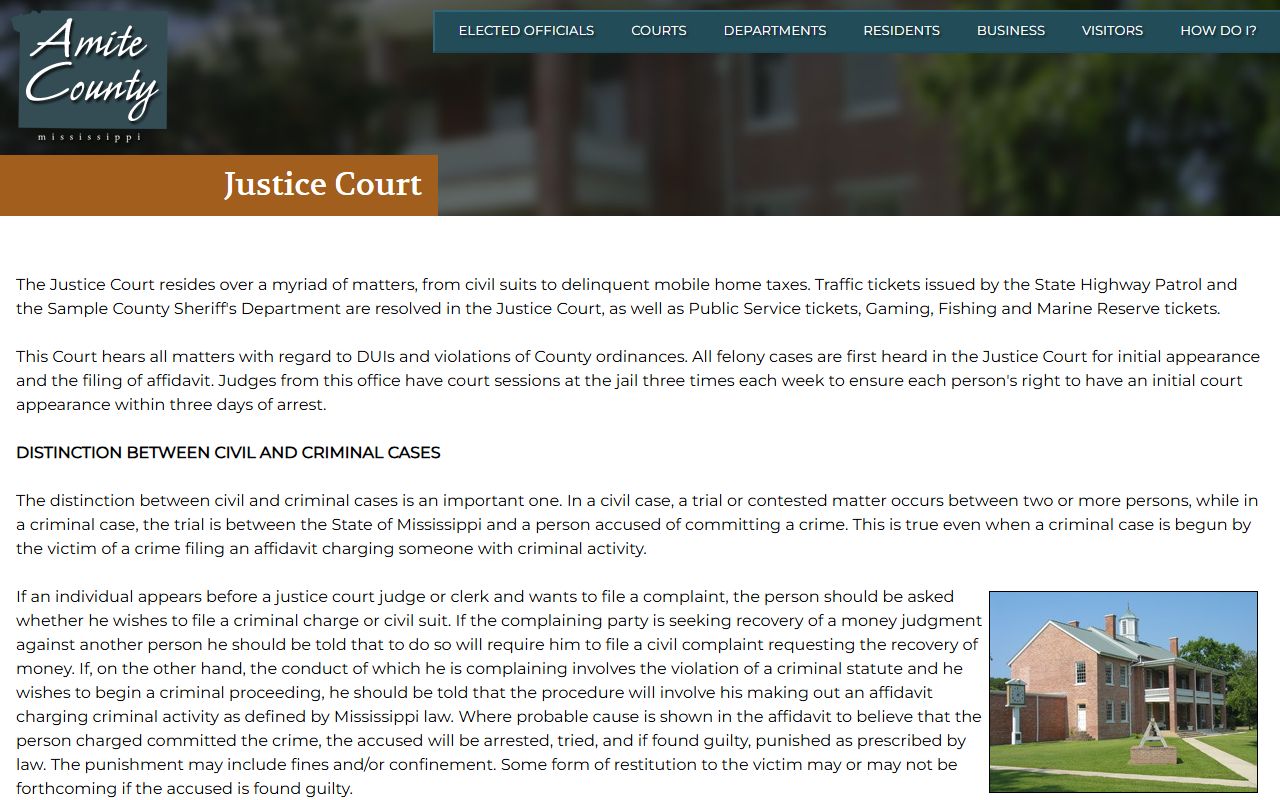
That court is where the first charge paperwork in many Amite County arrest records is created.
Charging Documents in Amite County
The court charge record formally begins with a charging document. In Mississippi, the document depends on the court and the seriousness of the offense. A sworn affidavit or complaint starts many lower-court matters in Justice Court. An information or an indictment carries felony charges into Circuit Court. One arrest can lead to more than one charging document over time, and the paperwork can change as the case develops.
The office of District Attorney Timothy Cotton files and prosecutes the most serious of these charges.
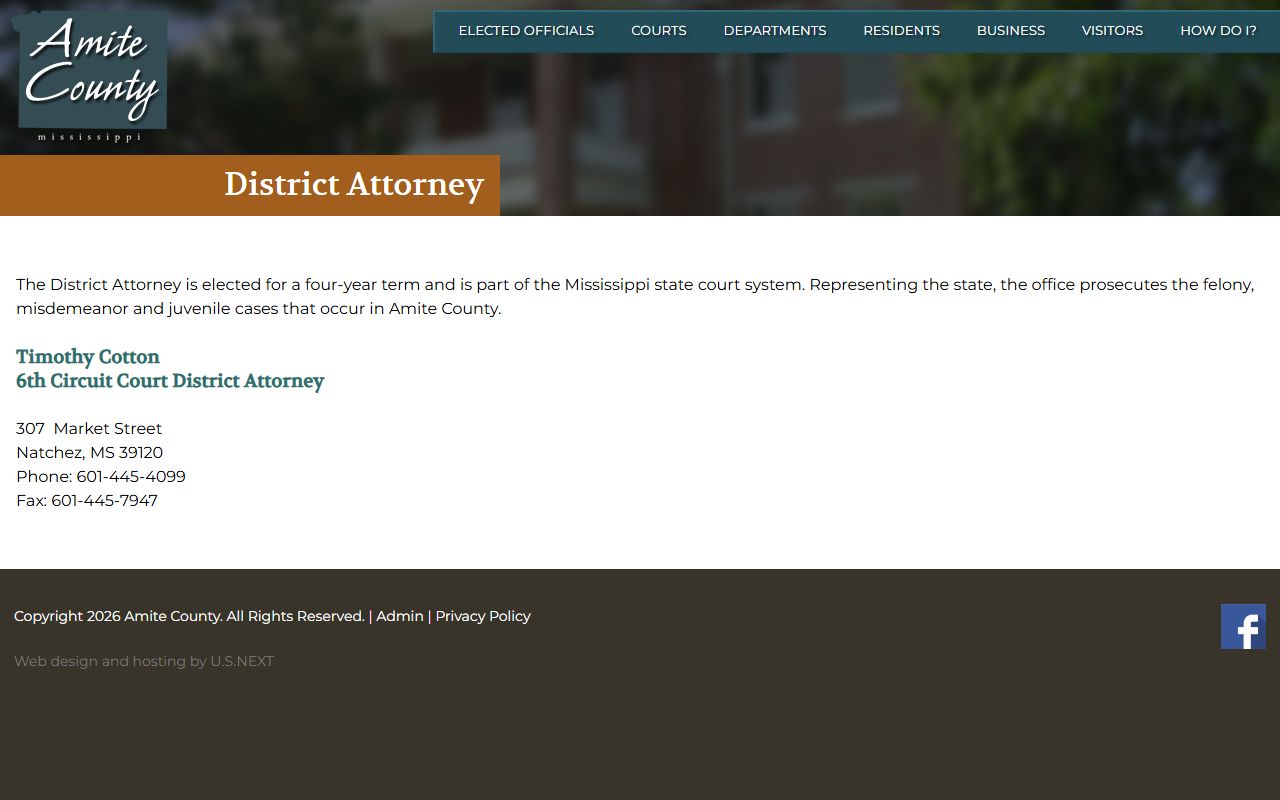
The District Attorney's review decides which felony court charges after arrest reach Circuit Court. The table below shows how the three main charging documents compare in Mississippi practice.
| Affidavit / Complaint | Information | Indictment | |
|---|---|---|---|
| Filed By | Officer or citizen, sworn before the court | Prosecutor | Grand jury |
| Court | Justice Court | Circuit Court | Circuit Court |
| Common For | Misdemeanors and early felony charges | Some felonies where indictment is waived | Felony charges |
| Begins | Lower-court charge or initial appearance | A felony case without a grand jury | A felony case in Circuit Court |
Charge Status and What It Means
Charges rarely stay frozen. As a case develops, the charge record is updated to show the current status of each count. The terms below appear often in Mississippi court files. Reading them correctly explains where a charge stands and whether it is still active.
| Status | What It Means |
|---|---|
| Filed | The charge has been formally entered with the court and is pending. |
| Amended | The charge language or count has been changed by the prosecutor or court. |
| Reduced | A more serious charge is lowered to a lesser offense. |
| Dismissed | The court drops the charge, ending it without a conviction. |
| Nolle Prosequi | The prosecutor chooses not to pursue the charge for now. |
| Bound Over | A lower court sends the charge up to Circuit Court for grand jury or trial. |
A single case can show several of these labels at once, because each count is tracked on its own. Bond and fine entries often sit beside the status, especially in Justice Court files.
Charge Codes and Severity Levels
Each charge ties to a statute. The code names the law alleged and sets the severity level. Mississippi sorts most crimes into two broad groups, with local ordinance matters as a third. The level decides which court hears the charge and how it is recorded. Justice Court handles misdemeanors, DUIs, and county ordinance violations, while Circuit Court handles felonies. A single arrest can produce several separate charges, each with its own code, level, and status.
- Felony. The most serious offenses, carrying possible prison time and usually charged in Circuit Court.
- Misdemeanor. Lesser offenses with jail or fine limits, often handled in Justice Court.
- County ordinance violation. Local rule breaches that Justice Court also hears.
Because codes refer to specific statutes, the same arrest can read very differently in the record depending on which counts the prosecutor files. Reading the code, not just the plain-language label, gives the clearest picture of what was charged.
Charges vs. Convictions in Amite County
A charge is an accusation. A conviction is a result. The difference matters when reading any Amite County arrest record or charge file. A person may be charged and later cleared, yet the original charge can still appear in the record. The comparison below sets the two side by side.
| Charge | Conviction | |
|---|---|---|
| Stage | Accusation | Verdict or plea |
| Burden of Proof | Probable cause | Beyond a reasonable doubt |
| Decided By | Prosecutor or grand jury | Judge or jury |
| Public Record | Yes | Yes |
A dismissed or dropped charge is not a conviction. The charge record may still list it, which is why people check the status of each count rather than the arrest alone.
Criminal Affidavits and Civil Debts
Amite County Justice Court publishes an unusual and useful warning. Its official page explains that civil cases are disputes between people, while a criminal trial is between the State of Mississippi and the accused. Anyone coming to court to file a complaint is asked whether they want a criminal charge or a civil suit. If the goal is to recover money, the correct route is a civil complaint. If the conduct breaks a criminal statute, the person may swear an affidavit charging a crime, and where probable cause appears, the accused can be arrested, tried, and punished by law.
Important: Justice Court warns that criminal process cannot be used to collect a civil debt, citing State ex rel. Richardson v. Edgeworth, 214 So.2d 579 (Miss. 1968).
This rule shapes how some charge records begin in the county. An affidavit filed for the wrong reason can be challenged, and the warning helps explain why a charge record sometimes notes a dispute over whether the matter was truly criminal.
How to Find Amite County Arrest Records and Charges
Charges and charge status show up in the court case index, not in a single county arrest portal. There is no county-branded online search that combines arrest and charge data in one place. The practical path identifies the court first, then uses the right clerk or the statewide system.
- Identify the court. Justice Court holds early felony appearances, traffic, DUIs, and misdemeanors, while Circuit Court holds felony indictments and trials.
- Try Mississippi Electronic Courts through PAMEC where the case is electronic. Public remote viewing requires registration, and per-page fees can apply.
- Contact the right clerk. Call the Circuit Clerk for felony Circuit Court files, or Justice Court for citations and early charge paperwork.
- Open the case and read each charge, its code, its level, and its current status.
- For booking and custody detail, call the Sheriff's Office, since arrest detail is not in the court charge index.
The official Amite County court systems page lays out which court handles each stage.
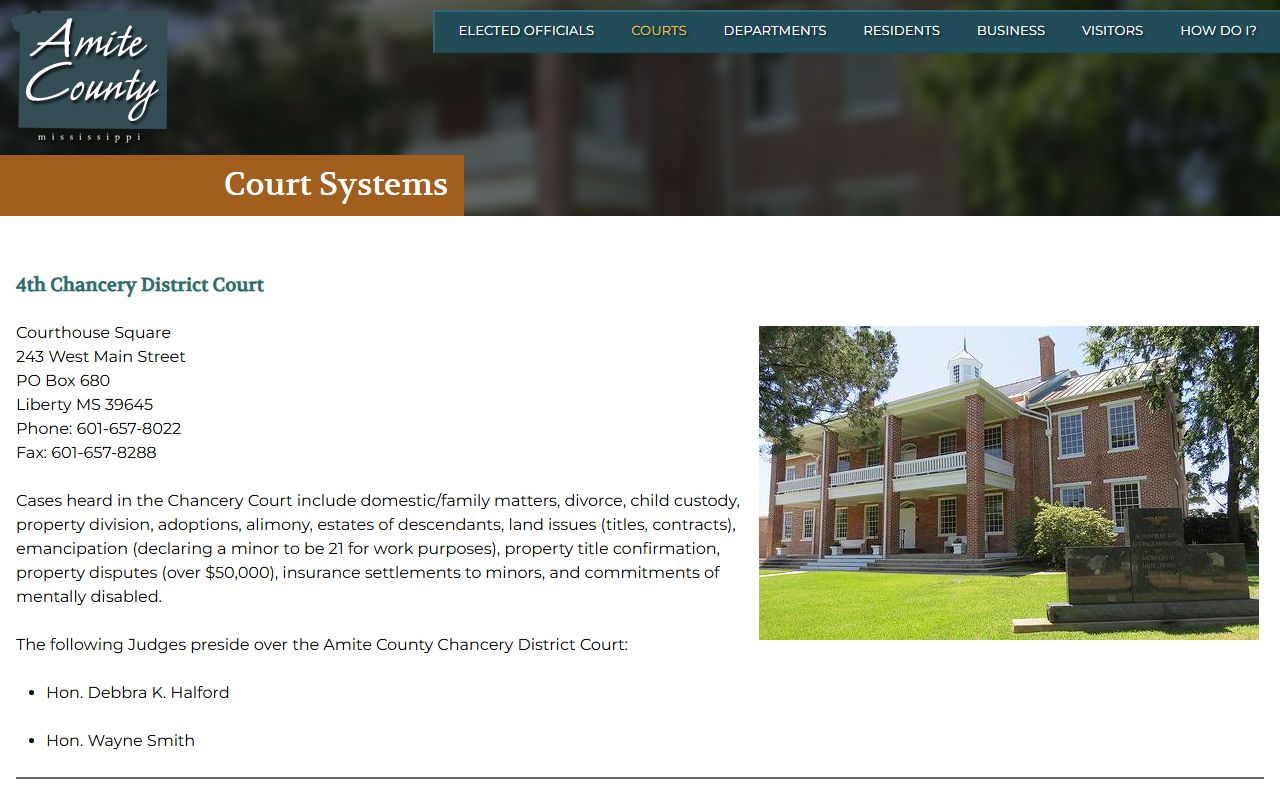
That page helps a reader match an Amite County arrest record to the court that now holds the charges.
Statewide Charge and Criminal History Lookups
Charges in local courts can roll into a broader criminal history. Mississippi has no single free public website that hands the general public a full criminal-history report. Records that are open under the Mississippi Public Records Act of 1983, Section 25-61-1, are still reached office by office. PAMEC is the statewide electronic route for many court documents, though access can be gated and paid. For people moved from the county jail into state prison, the Mississippi Department of Corrections inmate search is the statewide custody tool. A public-records request to the clerk or sheriff covers non-confidential charge records that have no online search.
Note: This site is not a consumer reporting agency under the Fair Credit Reporting Act and its data may not be used for employment, tenant, or credit decisions.
Restricted Charges in Amite County
Not every charge is open to the public. Youth Court charges are confidential and sealed under Mississippi Code Section 43-21-251, so the public should not expect them in ordinary searches. Sealed cases carry SEALED or Sealed_Case flags and are withheld without a court order. Active investigations and some warrant-stage records may also be limited at the counter. Public copies routinely redact Social Security numbers, financial account data, and details that identify a minor child.
Dismissed and nonconviction charges may qualify to be erased. Mississippi Code Section 99-19-71 allows eligible criminal records to be expunged. A petition is filed in the court that handled the charge, and the court reviews offense type, outcome, waiting period, and eligibility before entering an order. Once expunction is granted, the affected clerk and law-enforcement agencies process it so the record leaves ordinary public access. Amite County expunction forms and fees were not published online, so the Circuit Clerk or Justice Court should be asked about filing steps, proposed orders, and costs before paying anything.